Nourishing the Worthy
I ChingNourishing the Worthy is the political and ethical meaning attributed to Hexagram 50, The Cauldron. Its central image is an ordinary vessel transformed into an emblem of government: the state must sustain capable and virtuous people, whose service in turn enables public order and flourishing. The hexagram’s promise of great progress and success rests on this work of nourishment, not on abundance alone.
The Cauldron as a Figure of Government
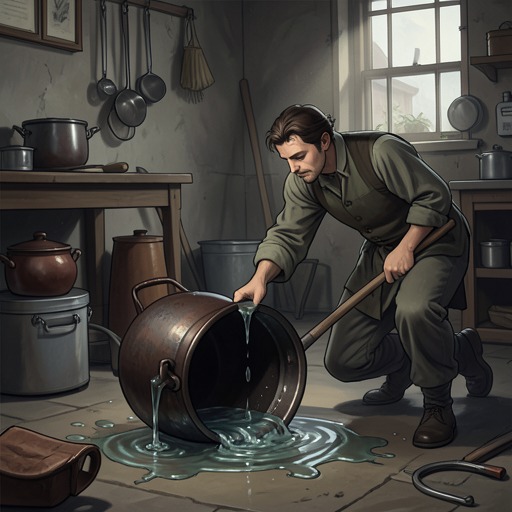
The cauldron is introduced as a cooking vessel with three feet and two ears, used to prepare food for the table and the altar. Its shape also gives the hexagram a visual structure: the bottom line is its feet, the three solid lines above form its body, the divided fifth line represents its two ears, and the top solid line is its carrying handle or suspension point. The vessel is therefore not merely named as an object; its parts are read across the six lines, making its material form the framework for the hexagram’s interpretation.
The text announces that The Cauldron intimates great progress and success. That auspice takes on a specific governing sense in the commentary: the vessel represents the work of nourishing people through political institutions. Its promise is not detached from the practical question of what a government provides and whom it supports.
Two Forms of Nourishment
The commentary distinguishes The Cauldron from Hexagram 48, The Well, even though both are named after objects in common use and both concern nourishment. The Well concerns the general provision of the people by government, through agriculture and other public methods. The Cauldron, by contrast, concerns nourishing people of talent and virtue. The distinction makes the hexagram’s political emphasis selective but public-facing: worthy people are sustained so that their abilities and conduct may serve the wider community.
This interpretation is connected to a broader account of nourishment in which sages sustain people of worth in order to reach the many. The cauldron thus belongs to a theory of rule where material provision, the cultivation of ability, and the benefit of the population are related but not interchangeable tasks. Its image turns the preparation of food into a measure of whether political order can support those who are fit to contribute to it.
The Lines: Reversal, Resistance, and Success
The first line presents the cauldron overturned, with its feet turned upward. The commentary records two readings of this initially adverse image: the vessel may be rid of what is bad within it, or the line may describe a concubine whose position improves through her son. In the first interpretation, the overturning empties accumulated bad material; in the second, an unpromising status changes when the son becomes heir because the proper wife has no child. The commentator reports these explanations but says he remains dissatisfied with them, leaving the line’s image unresolved even as its stated outcome is favorable.
The second line shows the cauldron with its food inside. Its subject can withstand an enemy’s approach, and the line promises good fortune. In the commentary, that enemy is identified with the first line’s solicitation: the subject resists it rather than yielding. The passage is also noted as rhymed, like the first, third, and fourth lines, and its first-person wording suggests that it was intended to function as an oracular response. The vessel’s contents remain protected, and resistance becomes the condition of the auspice.
At the other end of the sequence, the sixth line shows the cauldron fitted with jade rings and promises great good fortune, with every action advantageous. The progression from an overturned vessel at the bottom to a fully furnished one at the top gives the image a movement from compromised condition toward successful use. The commentary’s political reading clarifies what that success signifies: nourishment has value when it supports the capable and virtuous people on whom sound government depends.
Political Context and Interpretive Method
The book’s account places the interpretation of the hexagrams against the disorder of the Yin or Shang dynasty. A brother of the reigning king describes a land where government has lost authority, officials violate laws, crime goes unchecked, and people commit violence against one another. The account attributes this national crisis in large part to the monarch’s character and tyranny, including contempt for virtue, neglect of sacrifices, and the displacement of advisers. Against that background, nourishment and the employment of worthy people stand as questions of political responsibility rather than private generosity.
The commentary describes the hexagrams as short, symbolic essays, generally addressing moral, social, or political subjects. King Wen’s interpretation supplies the significance of each whole hexagram and may indicate what action its circumstances call for; the Duke of Zhou’s line texts then interpret each line through an emblematic example. In this account, the whole-hexagram interpretation is meant to harmonize with the combined significance of its lines. The Cauldron’s vessel, its food, and its successive conditions therefore work as a compact system of political instruction, while the text’s divinatory form allows that instruction to speak as guidance about conduct and auspicious action.